

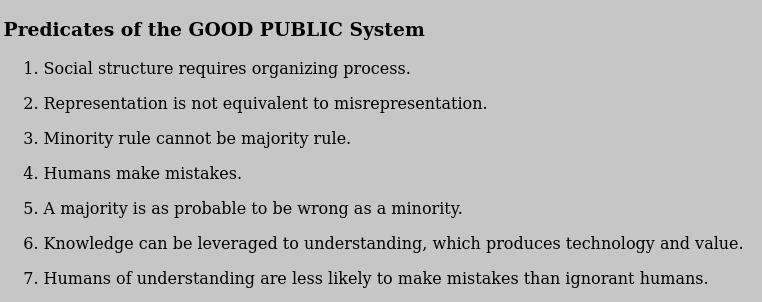
Is it TRUE that elections result in equal accurate and reliable representation?
OR, were you told to believe it for the convenience of the business of government?
I suggest we stop being obtuse on decision process used to organize social structure, (community, economics), with life and death consequence to humanity as a species and individuals.
This is a serious legal matter of decisions of law and policy, not a circus show for public entertainment and delusion.
I want the government specified to perform the function expected by a public that is committed to equal rights and responsibilities of liberty and justice for that majority of humanity that expect community to be kind as possible to each other.
I expect that government to administer the ultimate power of decision authority of the public. We the people.
I expect that government to implement representation of the public that is equal, accurate, and reliable.
“We, the people, united in our commitment to liberty and justice, establish this government as the administrator of our collective authority.
This government shall exist to uphold the equal rights and responsibilities of all citizens, to ensure that representation is accurate, reliable, and equal, and to foster a community guided by kindness, fairness, and reason.
The ultimate power of decision shall rest with the people themselves, whose consent and participation form the sole and legitimate source of authority.”
**** *****
The original intention of a Republic was to administer public authority for the common good through equal participation and representation of all citizens.
Election was later adopted as a means to achieve that end, but its failure does not alter the semantic or moral intent of the word “republic.”
A true Republic remains the government of the people’s public authority — its essence is representation, not election.
A “GOOD PUBLIC”….
Historical resonance
The Latin res publica literally meant “the public thing” or “the good of the people.”
Translating it back into modern English as Good Public revives its root meaning while discarding centuries of corrupted associations with parties and elections.
It reclaims the original ethical core of republicanism: governance as a moral public trust.
In essence, Good Public could be considered the restored meaning of republic — purified of electoral distortion.
The GOOD PUBLIC.
https://45ink.com/wp/4-branch-brief/
“Electing someone doesn’t guarantee your priorities are heard. Choosing a representative under the GOOD PUBLIC lets you define exactly where and how they act for you.”
Hey, in case you missed it, I am never going to support a system that elected nazi criminals..
For those who support that system, there is a story about a bunch of good people that sat down to dinner with a nazi…
When you tell me we have to keep using what we have, I hear you sayin that I should join the nazis at the table…
Nah. Not gonna do that.
When I suggest that we could choose a representative, instead of electing them, do you immediately imagine a screaming mob of 50, 60 thousand idiots shouting at each other in a bedlam congress?
Do you then ask, “Do you know how many representatives that would require?”
Sure you do. That’s what you imagined so it must be true.
Well the truthful honest answer from me, to you on that question, is no, I have no idea how many people would be chosen.
What I do know is that it does not matter how many representatives the public chooses, because what you are imagining has nothing to do with what I am describing.
NONE of those people chosen by the public to be representative, are in congress.
Now, are you confused yet?
Of course you are, because you imagined some nonsense instead of wondering how those people would not be in a congress.
Your faith based thinking, imaginative prediction based on experience with current systems provides you no basis of understanding an entirely different process.
shrugz
Your problem, not mine.
// ===========================
// GOOD PUBLIC GOVERNMENT MODEL
// ===========================

// ---------------------------
// Citizens and Representatives
// ---------------------------
CLASS Representative
ATTRIBUTES
AssignedCitizens[] // Citizens choosing this rep
InternalStaff[] // For batch handling and reporting
Certification // Must meet conduct, reporting, and service requirements

FUNCTIONS
SubmitBallot(Ballot) // Pass citizen ballot to system
ReportProcess() // Factual reporting of government actions to citizens
ENDCLASS

// ---------------------------
// Agencies
// ---------------------------
CLASS Agency
ATTRIBUTES
DelegatedOperations // Defined by law
AdministeredBy // Citizen-elected or appointed
Status // Active, Removed
FUNCTIONS
ExecutePolicy(Policy) // Operational execution only
ReportToPublicAndReps() // Full transparency
ENDCLASS

// ---------------------------
// Congress
// ---------------------------
CLASS Congress
ATTRIBUTES
Members[] // Elected experts (4 per state)
FUNCTIONS
DraftBill(Task)
ProposeAlternativeBills(Options[])
AssistInRightsCreation(ArticlesOfProtection)
ENDCLASS

// ---------------------------
// Petition and Initiative
// ---------------------------
CONST PetitionThreshold := 0.25 // Fixed 25% citizen population
CONST MaxBillRetention := 365 // Max days for a bill before retirement

FUNCTION ProcessPetition(Petition)
IF Petition.Signatures >= PetitionThreshold * Population THEN
IF Petition.Type == "Initiative" THEN
SendForJudicialAndExecReview(Petition.Bill)
ELSE IF Petition.Type == "Referendum" THEN
TaskCongressToDraft(Petition.Topic)
SendDraftForJudicialReview()
ENDIF
ENDIF
END FUNCTION

// ---------------------------
// Ballot and Dynamic Threshold
// ---------------------------
CLASS Ballot
ATTRIBUTES
Decision // Yes or No (mandatory)
ThresholdPreference // 51–95% (optional)
Valid // Decision present

CLASS Bill
ATTRIBUTES
Ballots[] // Submitted ballots
Status // Pending, Enacted, Retired
StartDate
ExpirationDate
Population // Total citizen count

FUNCTION CalculateDynamicThreshold(Bill)
CURRENT_DATE := Today()
IF CURRENT_DATE > Bill.ExpirationDate THEN
Bill.Status := "Retired"
RETURN "Bill retired: failed to achieve threshold"
ENDIF

VALID_BALLOTS := FILTER(Bill.Ballots, b => b.Valid == TRUE)
YES_VOTES := COUNT(VALID_BALLOTS WHERE b.Decision == "Yes")
NO_VOTES := COUNT(VALID_BALLOTS WHERE b.Decision == "No")

IF YES_VOTES <= (Population / 2) THEN
RETURN "Simple majority not yet reached"
ENDIF

THRESHOLD_CHOICES := MAP(VALID_BALLOTS, b => b.ThresholdPreference)
CALCULATED_THRESHOLD := AVERAGE(THRESHOLD_CHOICES)

IF YES_VOTES >= CALCULATED_THRESHOLD * Population THEN
Bill.Status := "Enacted"
RETURN "Bill enacted successfully"
ELSE
Bill.Status := "Pending"
RETURN "Bill pending; threshold not yet met"
ENDIF
END FUNCTION

FUNCTION DynamicThresholdMonitor(Bill)
WHILE Bill.Status == "Pending"
RESULT := CalculateDynamicThreshold(Bill)
LOG RESULT
WAIT IntervalTime // e.g., daily or twice daily
ENDWHILE
END FUNCTION

// ---------------------------
// Rights (Articles of Protection)
// ---------------------------
CONST RightsPublicationThreshold := 0.51 // 51% to publish
CONST RightsAmendmentThreshold := 0.67 // 67% to amend
CONST RightsRepealThreshold := 0.85 // 85% to repeal

FUNCTION ProcessRightAction(Right, ActionType)
YES_VOTES := COUNT_VALID_YES(Right.Ballots)
IF ActionType == "Publish" AND YES_VOTES >= RightsPublicationThreshold * Population THEN
Right.Status := "Published"
ELSE IF ActionType == "Amend" AND YES_VOTES >= RightsAmendmentThreshold * Population THEN
Right.Status := "Amended"
ELSE IF ActionType == "Repeal" AND YES_VOTES >= RightsRepealThreshold * Population THEN
Right.Status := "Repealed"
ENDIF
END FUNCTION